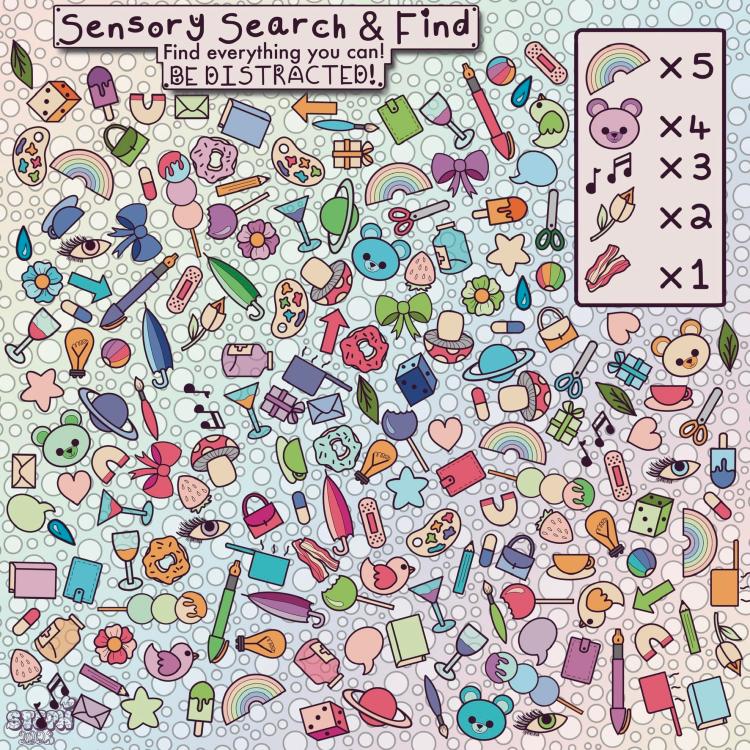
One of the most simple and effective distractions is using our senses to guide us. The image above was created by me as a basic sensory serach and find to distract you. See if you can find the bacon, bears, rainbows, notes and flowers. Then, see what else you can find!
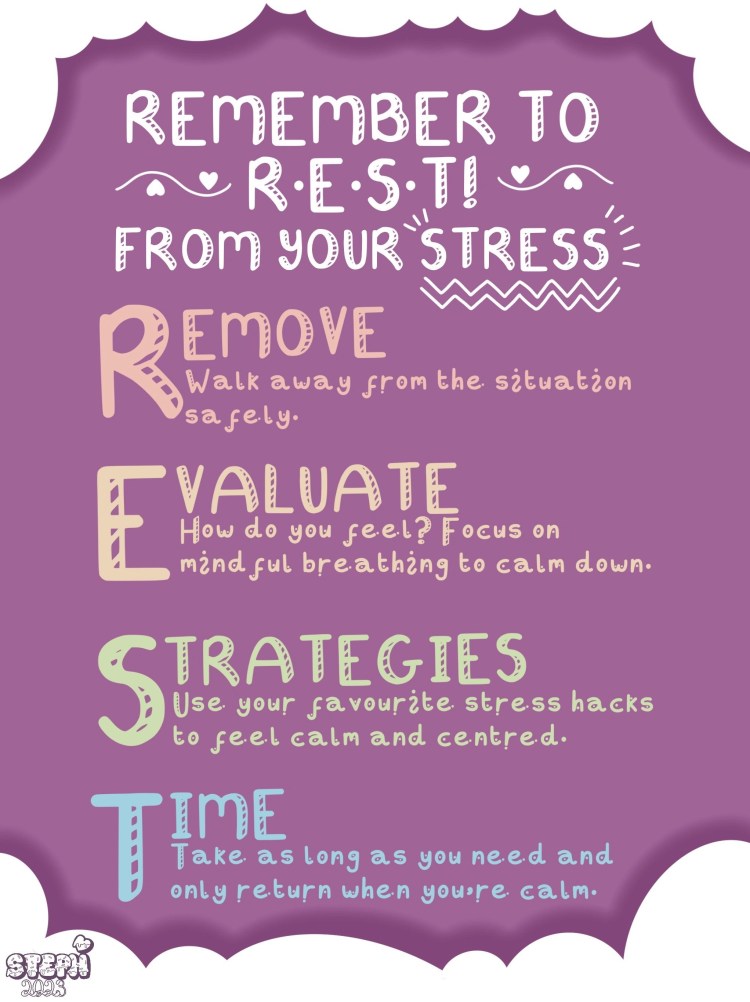
Feelings of touch, taste, smell, sight and sound can have a calming effect if we allow ourselves to be consumed by them for however long is necessary.
I’m going to use some words from a recent blog post to guide you here…
A helpline worker was trying to calm me down in an evening of stress recently. She told me to look aroud the room and try to find an item for every letter of the alphabet.
Yes, you may have guessed, I’m still looking for an ‘X’ word, and I have to be grateful to our daughter for accidentally leaving me with a zebra. Being in the bedroom gifted me a quilt too. Now, I’m certain, somewhere out there is a person reading this who is now also, just like me, looking around their room for something beginning with an ‘X’. My partner did the same thing when I told him about it. After I finished the phone call, I must have spent half and hour on this challenge alone – it was the first one I tried.
Sensory hack 1 – look around the room for an item that starts with each letter of the alphabet. You should end up with 26 items lettered from A to Z.
For the second task she told me to use my senses to connect with the things around me, then think about the properties of those things and make a list of what I feel. For example, in the past I’ve simply said you should think about the things you can see, feel, hear, smell and taste. It works as a distraction but it can be over faster than Usain Bolt puts his slippers on. During the phone call I was asked to talk about something I can feel. I chose our ‘magic blanket’ and I told her I was holding the blanket and it was soft to touch. So basic. She asked me questions – ‘How does it feel when you touch it?’, ‘What colour is it, and does the colour change when you stroke it?’, ‘Are there other things in the room that match it and how do they feel?’. The list went on and on, and before I knew it, I’d been telling her about the incredible powers of our blanket for a few minutes. When we’d finished I scrutinised, fondled, sniffed, glugged and tuned in to as many things as I could, thinking carefully about the questions I could answer about them, and even wrote some down to keep myself in this helpful sensory-zone.
Sensory hack 2 – look for an item you can smell, then an item you can taste, followed by an item you like to touch, something you can hear, and something you can see. Scrutinise each one for a while.
The final idea she gave me was, at it’s core, about counting…with a twist. Just like the alphabet task, this was about using my environment and finding items in quantites counting down from 10. Again, because I was in the bedroom (as usual) I had plenty to play with, +l my make-up brushes to my knicker drawer – once I started to scratch the surface it was clear there was plenty around me to calculate.
Sensory hack 3 – count items around you and find things in groups from one to ten. You should end up with 10 groups of items.
Of course, you can cross-pollenate these tasks if you run short of answers. Using the counting game to find items then using the sensory challenge to think about their properties is a good example of this.
This is a waste of time, surely?
I get that these challenges seem childish, like a pointless passtime that you gain nothing from. It’s an understandable assumption, but it doesn’t address the point. The fact is, when your mind is reeling through such a high level of worry, it’s nigh-on impossible to apply yourself to something complicated, which is why my own creative juices have been failing throughout the last few weeks. Sometimes the BEST distractions are the silliest, simplest, pointless tasks, and the lady on the helpline was brilliant at reminding me of this.
But I have to stress, these solutions won’t solve the underlying problem. It’s a distraction for a reason – the stress you’re managing will likely still be there afterwards. So, I’ll be honest, as that evening and the following days wore on, so did my relentless headache and unstoppable anxiety and until our daughter is back to full health, I have to expect more of the same.
But in just twenty minutes a stranger didn’t just listen to my anxiety as it poured out of me, she gave me the tools to try and manage if and when it happened again, which it did a few days later.
These ideas worked for me while I was upset and waiting for a helpline to answer (nearly an hour in total) so they might help you in the same way.
For more help with stress, visit my stress hacks page, adults only stress hacks, kid friendly stress hacks and sleep hacks for loads more ideas.
My stress distraction tools page has stress relief ideas to help with short term upset such as when your sat on hold for a prolonged period.
My mental health and suicide prevention support lines page has contact information and opening times for various organisations who can assist with mental health concerns. If I’m doing, call your GP or the NHS 111 service for proper long-term support
*You must not rely on the information on this website as an alternative to medical advice from your doctor or other professional healthcare provider. If you have any specific questions about any medical matter you should consult your doctor or other professional healthcare provider. If you think you may be suffering from any medical condition you should seek immediate medical attention. You should never delay seeking medical advice, disregard medical advice, or discontinue medical treatment because of information on this website.
 Creative Steph