Fuck I’m old. 41 years on earth, yet I’ve barely learned a thing about effectively managing my stress, frustration and/or general upset.
Recently I found myself thinking about the impact some people have on my life without ever fully knowing how important they are. Admittedly I’m unusual because of my social isolation, but there are organisations who regularly have contact with us all (banks, take away drivers, couriers, newsagents, baristas etc) but don’t realise their impact. Something as simple as ‘have a nice day’ from an Amazon Driver as he walks away from our door makes a huge difference to me.
Unfortunately, the negative impact of frustration from the same companies has just as much power. Actually, no, it has more.
For me, this means when the interaction I have with them is unwelcome, I get very pissed off. I think it’s something I’ve talked about before, but today it got me thinking – is it a ‘Steph’ thing, or is it maybe a generational thing? Are we all hard-wired to get angry when things go wrong? Is it a result of life in the 80’s and 90’s?
Am I too angry because of my age, and therefore too entitled?
According to Google I’m part of Gen-X, the generation of children born between 1965 and 1985, and it was a great time to be a kid. We had everything available to us – She-Ra and He-Man were dominating the television with Grange Hill and Byker Grove coming on straight after. Riding your bike around the local streets with your friends all day long was not only fun, it was safe and it was essential. Dads spent Sundays washing cars and mowing lawns, while Mums spent them cooking roast dinner and hoovering. Scott and Charlene were showing us what true love looked like. Jimmy Saville, Rolf Harris and Gary Glitter were very famous for very different reasons.
It was a time of indifference, the last time I remember misogyny being acceptable, a time of missing danger, turning your head the other way, and becoming more distant from those you love through the normailty of evolving electronic communication. If milennial milestones were adults, the 80’s and 90’s were greasy, spotty and pubescent.
It was a simpler time, but (for me at least) also a time of plenty. In the early 90’s the expectation of everything, in excess, in an instant, became the norm. Binge drinking, previously saved for Christmas, summer barbecues, and Stag parties, was a twice weekly event for a lightweight. Smoking was the norm, and if you didn’t puff away 20 Benson and Hedges a night you’d expect to be scolded for it (despite the known health implications). Take aways stayed open after the club closed, and (thanks largely to the meteoric rise of Ronald McDonalds empire) fast food got even faster, so delicious hot scran was available whenever you fancied it. Supermarkets became 24 hour, as did the television, taxis, and sex chat lines. If you wanted it, it was available any time.
Life before Gen-X was obviously different, but when you start considering the urgency with which the population wanted ‘stuff’ and the reaction of businesses to quickly meet the demand, you realise that this new generation was given an easy route to having their cake, eating it, then ordering a second cake on their mobile phone for later.
The people I knew that belonged to generations before mine didn’t apply the same levels of urgency to their needs. We laugh at parents who don’t get the internet and fumble over a text message, but this might be part of the reason why. The slower, simpler, calmer life is often a happier one so the ability to see, read, chat, and order anything in an instant might look a bit like overkill to them. When I get frustrated because of delayed deliveries, I look in the mirror and wonder why I’ve become so desperate for quick fixes, because my Mum didn’t impart this fast-paced style of living on me.
Which leads me neatly on to my point…
In recent weeks I’ve been in a few disputes with companies who’ve made mistakes with deliveries. Items have arrived late, damaged and, in one case, not at all. At Christmas this was especially stressful, because I don’t have the luxury of visiting the high street – I was relying on them. These should all be simple things to manage, but for some reason, with every problematic delivery, my anger inflated. Mistakes that should have been resolved simply somehow get worse, and I felt my blood bubble.
Was I right to get so fired up? Is this how my parents would react?
Now, everyone is justified at being disappointed when things go wrong, but that’s just it – thing’s DO go wrong. Not everyone is bloody perfect, it’s usually just unfortunate when it happens to us. After an hour or two reminding myself of this and letting it settle in, I tend to calm down and speak to the seller in question so the problem is fixed.
Why, oh why, do I get so angry when it goes wrong again? Because, looking back honestly, the anger I feel when my frustration skyrockets is juvenile, like a child who can’t have an ice cream. I’m throwing my toys out of the pram over something I have no control over. To be honest, retrospectively I’m a bit embarrassed by it, but in the heat of the moment it’s hard to control.
Even though it’s an easy gear for me to find, I hate what increased stress causes in my brain and body. Not just anxiety and tears, oh no. Headaches, toothaches, digestion problems, days of lost appetite, sobbing, confusion, paranoia, anxiety, hair loss (in the places I want it to stay), getting ‘stuck’ and, worst of all, hours and hours of lost sleep. I can’t think of a single person from an older generation who’d lose sleep over a damaged delivery, yet I do.
Although it’s not the whole problem (clearly my poor mental health has a big impact on all this), I believe that belonging to Gen-X might be partly to blame. We only know a world where everything is available to us immediately, and we believe things should go perfectly. Of course, if it goes wrong we want it fixed yesterday, followed by a large cheque to compensate for the cardboard we found in that fish finger sandwich. £1.5 million should cover it.
It’s silly, isn’t it? I jump too fast to anger, then turn that rage back at myself when I stupidly believe an organisations promise to ‘put things right’, only to be let down a second time. You’re damned if you do, you’re damned if you don’t (thanks Bart).
So, are we, the people, totally to blame? Maybe not.
I think Gen-X businesses are playing a part in all this too. If they look closely at the expectations they set through pricing, delivery pace and advertising, they’d understand why customers get so angry and seem so demanding. Sadly, the same applies to the NHS.
For example, when a business sells a product online with next day delivery (and a price tag higher than a supermarket equivalent), I believe their ability to put any failings right should match the expectations created when purchasing. You offer next day delivery when I buy from you, a replacement for the damaged item I received should come at the same speed, surely? When it doesn’t, I am genuinely disappointed at the priorities the company has, and my frustration rises. You can’t put paying customers first and customers who receive damaged products somewhere at the end of the queue and have the audacity to call that good service. Or can you?
If the original delivery took a few days, then I’d believe the replacement delivery to be the same speed (certainly not slower), and I think this is a fair expectation to place on businesses selling online.
With the NHS, although we’re talking about a government run organisation rather than a business, the same ‘expectation vs. reality = angry customer’ paradox can be created. Many of you will have the same experiences of the NHS 111 service that I do. A lengthy questionnaire about symptoms usually followed by an offer of a callback within a certain timeframe, appointment booking, or UTC/hospital visit.
So, when the callback is offered and they say, for example. It’ll be within 6 hours, my expectation is set that I’ll hear back in that timeframe. When 12, 24 and 36 hours pass and I haven’t heard anything, I steadily become more and more frustrated, upset and concerned. I know the service well having used it for myself and my child several times over the years, but as demand for the service has risen, the ability to provide the same quality and speed of action has reduced. That means the expectations THEY SET just can’t be met.
The 111 service is a product of many Gen-Y and Gen-X minds, so they clearly knew that a round-the-clock healthline service was needed for this growing population. When it was working as they intended it was a great service – it filled a void. But they didn’t recognise the need to meet the expectations they set, and that failing to do so creates a vortex of frustrated patients and their carers, most of whom have no where else to go and are often very worried.
Saying that, I must stress that NHS staff should never face verbal or physical abuse. They are doing a job that is woefully underpaid and dangerously underfunded in conditions that desperately need updating. They do the job despite these problems, purely to help other needy people. I’d struggle to think of a more noble vocation. It’s the organisation itself that needs fixing. The frustrated patients and carers only get to speak to the staff on site or on the phone, and when you’ve been let down you need to say so and ask for help. Staff are the face of the organisation, and the anger ends up directed at them when they aren’t at fault at all.
I can understand why it gets heated, I can understand why patients are upset and angry at times, I can understand why staff have had enough, I can understand why they see no other option than strike action. I just can’t understand why the organisation itself, the big wigs at the top, don’t see the problem and do something about it.
Rant over…
The NHS has executives and governmental ministers making the decisions, and yes, they are often bad ones. But businesses have their own power, power to change internal process and procedure at the drop of a hat, and therefore learn from mistakes and better manage customer expectations and experience.
The Gen-X urgency is born from a fast-paced culture, and if the people, the products and the planet are to survive, then surely the slower pace my mum enjoyed has to be adopted once more?
I don’t care if it takes another day. I don’t care if it takes another week. I just don’t want to be lied to, and that’s about respect, not the generation I come from.
Oh, and I want the friendly, warm, talkative van drivers, bike riders and cyclists to stay. They are hard to come by and improve my day immeasurably.
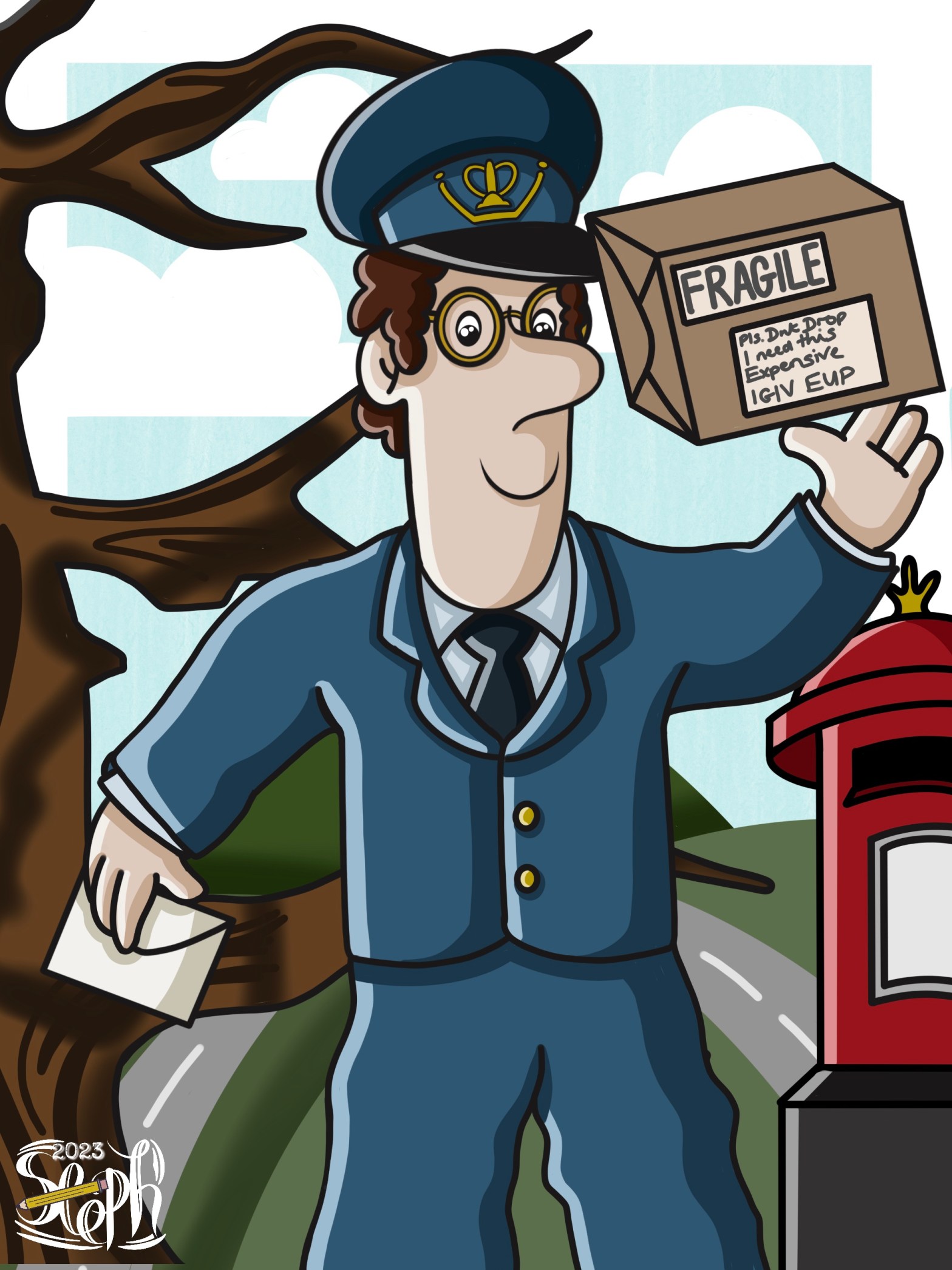
The picture
Look, I’m struggling with creative inspiration at the moment, so I went full-blown route-one on this.
Postman Pat, the go-to 80’s delivery man and the only male at the time willing to openly admit his noseiness and obsession with his cat, was a huge part of my childhood. The BBC set a precident with him that I don’t think real-life couriers can live up to, and maybe that’s another part of this problem?
Just like my first boyfriend, in the eyes of my father, he didn’t work hard enough.
Thanks for reading 💜✉️💌
 Creative Steph